Quilceda Creek, Allen Creek and the 70 Small Streams
How two creek watersheds drain the city, and what that means for low lots.
MARYSVILLE, WA · NORTH SNOHOMISH COUNTY
A brown ring creeping across a Sunnyside ceiling. Laminate rising beside the dishwasher in a Smokey Point kitchen. Creek water under a crawlspace hatch near the slough. Marysville's water damage line: (360) 502-8980.
Water damage restoration in Marysville starts with stopping the water and getting it out. Then the wet drywall, flooring and framing are dried until a meter shows they match the dry parts of the house, and anything that had to be removed is rebuilt. One call starts it: (360) 502-8980.
A city built on two levels. Marysville runs north and south along I-5, with the Tulalip Reservation on its west side and State Route 9 to the east. The old town grew up on low ground beside Ebey Slough, where ten sawmills were working by 1910. Most of what came later sits higher: the subdivisions of Sunnyside, Whiskey Ridge, Getchell and Smokey Point, many of them added to the city through annexations in the early 2000s. Low houses and high houses take on water in different ways, and this page is laid out around that difference.
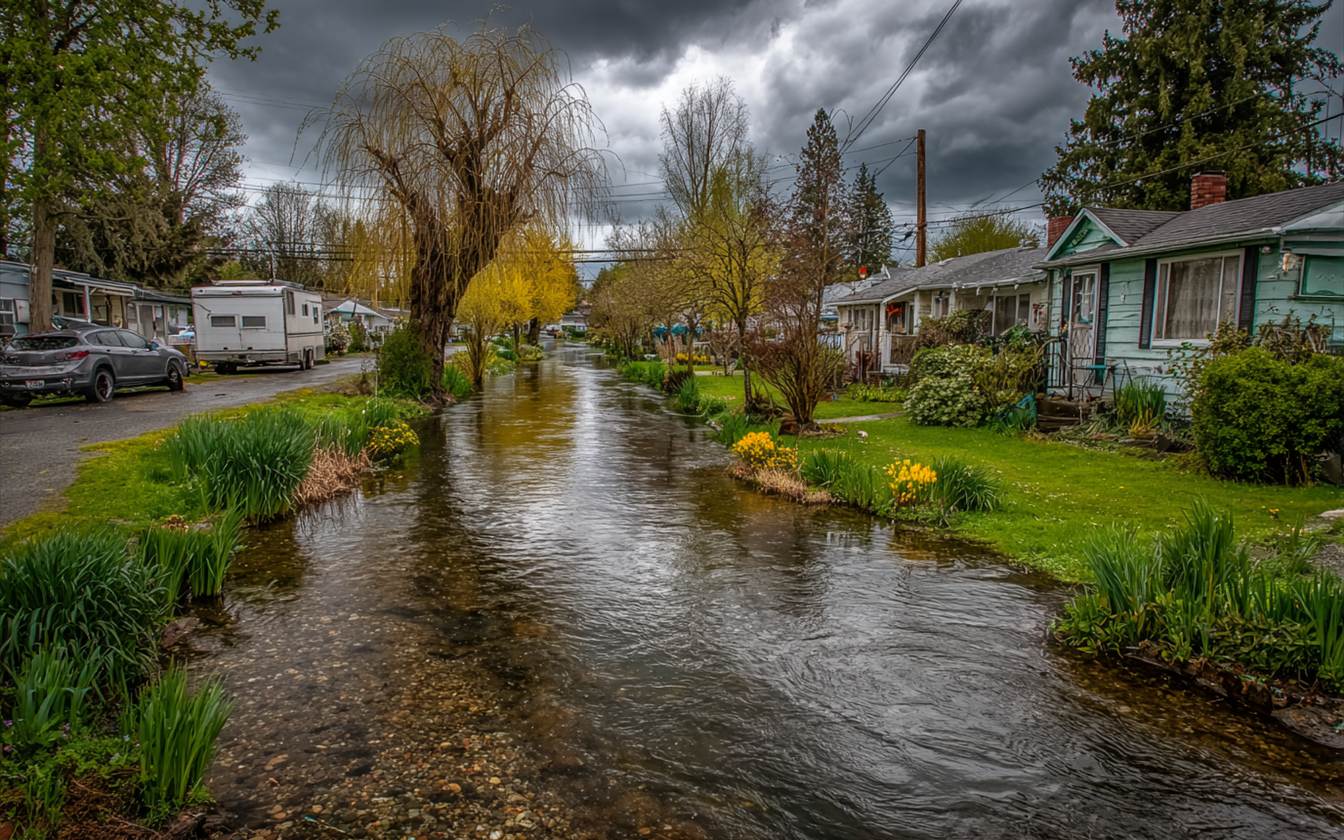
And a city laced with creeks. Quilceda Creek and Allen Creek drain most of Marysville, along with about seventy smaller streams that run to Ebey Slough and the Snohomish River. Ditches, culverts and low back yards are part of daily life here, and after a long rain they're where the water shows up.
Most homes here are owner-occupied. About seven in ten Marysville homes are lived in by their owners, according to the Census. So the person who finds the water is usually the person who decides what happens next. That's why the pages here lead with what you saw first, a stain, a floor, a pipe or water from outside, rather than with paperwork. If you rent, tell your landlord in writing first, with photos and the date. The landlord usually arranges the work.
What this site is. Marysville Water Damage is a website and a phone line. Your call goes to an independent restoration company that works in north Snohomish County. That company decides with you what gets done, when, and for how much. Nobody from this site comes to the house.
The same storm does different things to a house near the slough and a house up on the plateau. Here's how they usually differ.
| What to look at | Slough-side and creek-side homes | Plateau homes |
|---|---|---|
| Under the floor | Often a crawlspace, sometimes on ground that stays damp all winter | Mostly crawlspaces and slabs on newer lots, with garages at grade |
| Where water usually starts | Ground water, a saturated yard, a ditch or creek that backs up | A supply line, a water heater, a washer hose or an upstairs bathroom |
| What to watch after a long rain | Standing water under the house, a wet line on the lower wall, a musty crawlspace vent | Stains on ceilings below bathrooms, swollen floor seams, water around the garage heater |
| The page that fits | Yard and creek water | Pipes, heaters and appliances |
Down by the slough: Downtown and the waterfront, Jennings Park. Up on the plateau: Sunnyside, Getchell Hill. Not sure which you are? The pages work either way.
Most Marysville calls start in one of five places. Each line below points to the page that covers it.
A stain that shows up under a bathroom or near a light fixture, and keeps growing. Ceiling stain spreading? (360) 502-8980. Stains on ceilings and walls
Laminate peaking at the seams, vinyl plank that clicks loose, hardwood that cups into little valleys. Floor lifting or soft? (360) 502-8980. Floors that changed
A tub edge with failing caulk, a toilet that rocks, a shower pan that leaks only when someone's in it. The water usually turns up in the room below. Bathroom and fixture leaks
The dishwasher supply, the ice-maker line, the hoses behind the washer. These fail quietly and spread under cabinets and floors. Pipes and appliances
On many plateau homes the heater sits in the garage. When the tank or a fitting goes, water runs across the slab toward storage and the house door. Water heaters and pipes
Wet in two rooms, or you can't tell where it began. A restoration company finds the source, gets the water out, dries to readings and rebuilds. North county restoration, one number: (360) 502-8980. Restoration and mitigation
A soaked carpet, an inch across the laundry room, a puddle that keeps spreading. Extraction comes first. Water standing right now? (360) 502-8980. Removal and extraction
Brown rings overhead, bubbled paint low on a wall, a soft spot in the drywall. Ceiling stain spreading? (360) 502-8980. Ceiling and wall stains
Seams lifting, boards cupping, a spot that gives underfoot. Floor lifting or soft? (360) 502-8980. Floor water damage
A burst line, a leaking tank in the garage, a washer hose that split. Shut the water off, then call (360) 502-8980. Pipes, heaters and appliances
A creek over its banks, a ditch backing up, a yard so full it drains toward the foundation. Creek water at the door? (360) 502-8980. Yard and creek water
Down by the slough
Up on the plateau
Smokey Point and Lakewood
North along the Stillaguamish
East toward the foothills
Because the water that made it is still up there. Drywall and insulation hold water like a sponge, and a slow leak from a bathroom or a supply line doesn't care about the weather at all. If the ring gets wider over a few days, something is still feeding it. A restoration company can trace it with a moisture meter before the ceiling sags.
Very often, yes. Laminate has a fiberboard core that swells when water reaches it from below or from the edges, and the surface can look dry while the core and the subfloor are wet. Dishwashers, fridge lines and bathroom leaks are the usual sources. Once the seams peak, those boards rarely flatten again.
It changes where to look. Homes close to the creeks and their ditches sit nearer to the water table, so watch the crawlspace and the low side of the foundation after long wet spells. Water under a house can stand for weeks without anyone noticing, and it soaks the framing and insulation above it.
How two creek watersheds drain the city, and what that means for low lots.
What a stain's shape, color and location suggest about its source.
Supply lines, garage water heaters, upstairs laundries and ice-maker lines.

